The Western Saddle: How Design Shapes Riding Experience
The Western saddle is much more than just a piece of equipment. It is an icon of the West, designed for a full day’s work and built to offer maximum comfort and security for both the rider and the horse.
Key Features of the Western Saddle
The Western saddle was developed for cowboys who spent long hours on horseback working cattle. Its design is, therefore, focused on stability, comfort, and safety for the rider.
For this reason, it has several unique parts that you won’t find anywhere else.
The Horn and Swell: A Safe Anchor
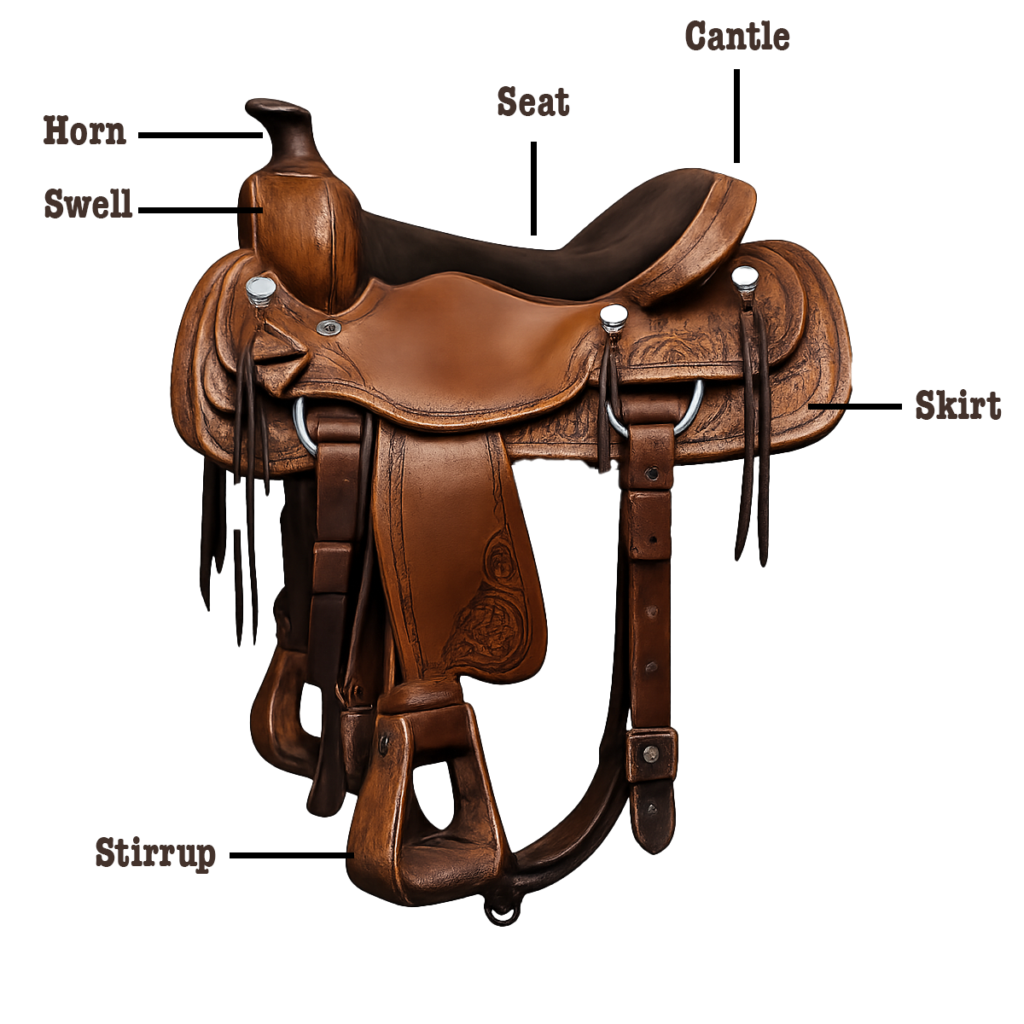
The most visible and distinctive part is the Horn. This is the thick, rounded knob that sits at the front of the saddle.
Historically, cowboys used it to tie a rope, or Lariat, after catching cattle. This technique is called Roping. Today, even if you are not working cattle, the horn serves as an extra handle for balance, especially for beginners.
The area just behind the horn is the Swell. This is the wide part that helps hold the rider securely in place.
The Deep Seat and Wide Skirts: Ultimate Comfort
Unlike English Riding, Western riding often means long hours in the saddle. That is why the saddle is designed to spread the rider’s weight over a larger area, which is better for the horse’s back.
The seat of the Western saddle is wide and deep. It allows the rider to sit more relaxed, almost like in an armchair.
Large pieces of leather called Skirts extend under the seat. Their role is to ensure a uniform distribution of pressure to prevent sore spots on the horse’s back during long hours.
The Large Stirrups: Safety and Support
When you look at a Western saddle, you immediately notice the size of the Stirrups. They are often covered with leather and are much wider and heavier than the thin metal stirrups used in English riding.
The reason for this size is twofold: comfort and safety.
- Comfort: The wide, flat bottom of the stirrup supports the entire sole of the rider’s boot. This prevents the foot from tiring and aching during long days of riding.
- Safety: The size is designed to make it nearly impossible for a cowboy’s large work boot to slip all the way through the stirrup. This is a crucial safety feature, preventing the rider from being dragged by the horse if they fall off.
English vs Western Riding: The Major Differences
If you are used to an English saddle, the Western saddle can seem huge and complicated. In reality, every difference relates to a very specific riding purpose.
Size and Weight
Feature |
English Saddle |
Western Saddle |
|---|---|---|
Weight |
Light (often 10 to 20 pounds). |
Heavy (often 35 to 55 pounds). |
Purpose |
Allows freedom of movement, jumping, and speed. |
Spreads weight over long distances, heavy work. |
The Western saddle is much heavier because of its Tree. The tree is the rigid internal structure, often made of wood covered in fiberglass. It must be strong to handle the strain when cattle are tied to the horn. The English saddle has a much lighter and thinner tree.
Contact with the Horse
One of the main differences is the contact between the rider and the horse.
The Western saddle, with its wide skirts and thick seat, reduces direct contact. The rider mostly communicates through subtle leg cues and Neck Reining, where the rein laid against the horse’s neck tells it which way to turn.
The English saddle is minimalist and encourages close contact so the rider can give small, precise aids with their legs.
Security and Stability
The Western saddle offers much higher stability thanks to its deep seat, the Swell at the front, and the high Cantle (back rest). If your horse does a sudden stop (Sliding Stop), your body stays in place much more easily.
The English saddle has a flat seat that does not hold you in as much. It allows the rider to stand up in the stirrups (Suspension) to follow the horse’s movement at a gallop or over a jump.
The Riding Experience
The Western saddle is designed to be stable and reliable, letting you focus on the work or the trail ride, not on your balance.
As a beginner, it gives you a solid foundation to build your confidence and your aids. It proves that equipment design is essential to shape the riding experience, whether you are working cattle or just enjoying a relaxing sunset ride.

Leave a Reply